
GST, IEC, Current Account and Udyam: What Should an Exporter Register First?
Understand the practical order for GST, IEC, Udyam and business banking when starting an export business in India, including what is mandatory, optional and dependent on your setup.
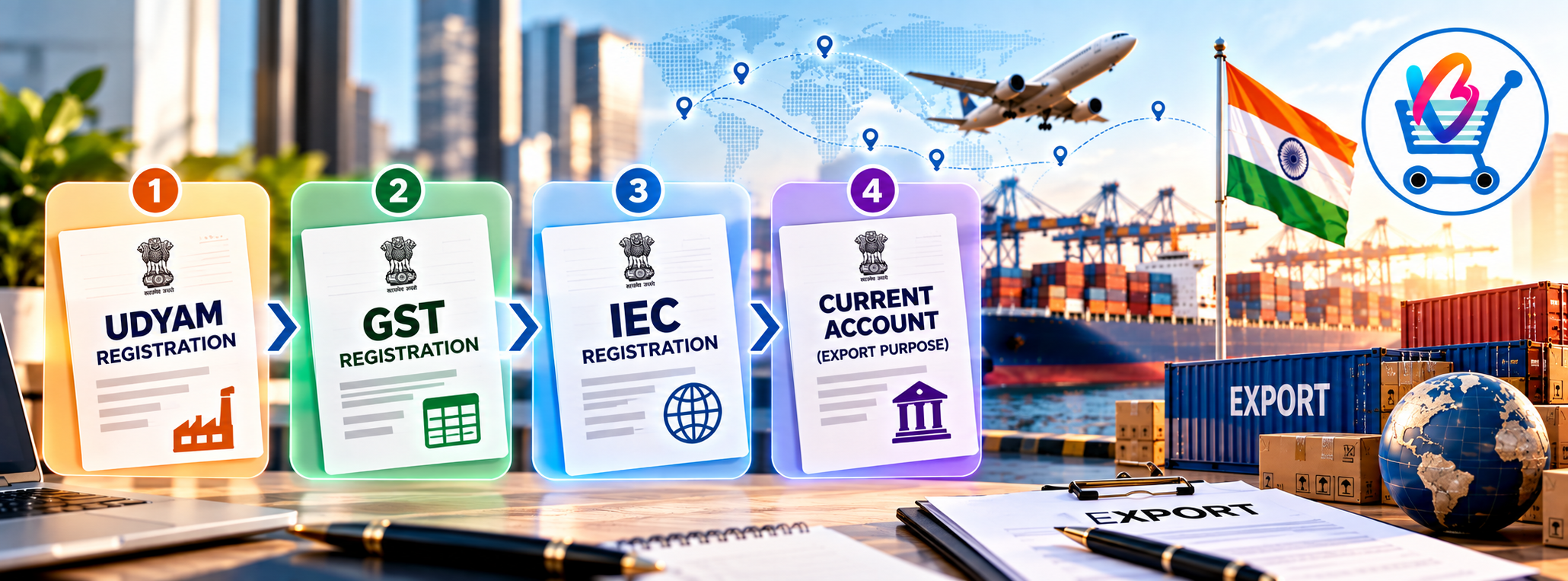
There is no universal rule requiring every Indian exporter to complete GST, IEC, a current account and Udyam in one fixed order. For many new commercial exporters, the practical sequence is: establish the correct business/PAN identity, open the appropriate business bank account, resolve GST registration where applicable, complete Udyam if the enterprise is eligible, and obtain IEC before import-export activity where IEC is required. Udyam is not a prerequisite for IEC, and a current account is a banking facility rather than an export registration.
- There is no single mandatory order for GST, IEC, a current account and Udyam in every business case.
- Business/PAN identity and banking should usually be settled early because IEC uses PAN-linked entity and bank information.
- GST and IEC are separate systems; GST treatment depends on the applicable law and intended export workflow.
- Udyam is an MSME registration, not an export licence and not a prerequisite for IEC.
- IEC is generally required before import-export activity, subject to DGFT exemptions, but it does not complete customs, GST or product-specific compliance.
There is no single government rule saying every exporter must complete GST, IEC, a current account and Udyam in one fixed order. These items serve different purposes. A practical sequence for many Indian businesses is to first establish the business and PAN identity, open the appropriate business bank account, obtain GST registration where applicable or commercially required for export compliance, register under Udyam if the enterprise is eligible and wants MSME recognition, and obtain IEC before carrying out import-export activity where IEC is required. The exact sequence can change with the business structure, product, GST position and bank requirements.
| At a glance | Summary |
|---|---|
| Topic | GST, IEC, Current Account and Udyam: What Should an Exporter Register First? |
| Core answer | Use the Quick Answer above for the direct answer, then use the sections below for the practical process, checks and next steps. |
| What to remember | Why it matters |
|---|---|
| Editorial note | There is no universal registration order for every business. Map the dependencies for your entity, banking, GST, Udyam and IEC requirements before acting. |
| Area | Question to resolve |
|---|---|
| Entity | Who will contract and invoice? |
| Banking | Which business/current account is used? |
| GST / Udyam | What applies to this business? |
| IEC | Is it required for this import/export activity? |
Related step: Udyam guide.
If you are still planning the wider export business, read How to Start an Export Business from India before treating registrations as a checklist by themselves.
1. First Understand What Each Registration Actually Does
| Item | Main purpose | Is it always mandatory? |
|---|---|---|
| Business current account | Business banking and payment operations | Depends on entity, bank and business setup; not an export licence |
| GST registration | GST compliance, reporting, zero-rated export procedures and eligible refund/LUT workflows | Depends on the applicable GST law and transaction |
| Udyam Registration | MSME recognition under the Ministry of MSME | Not a prerequisite for IEC; useful for eligible MSMEs |
| IEC | Importer-exporter identity under DGFT | Generally required for import/export activity, subject to specified exemptions |
2. Start With the Business Entity and PAN Identity
| Next step |
|---|
| Build a structured company and product presence so relevant B2B buyers can understand what your business manufactures, supplies or trades. |
List your business on BulkVyapar
Before deciding between GST, IEC or Udyam, make sure the business identity itself is clear. A sole proprietor, partnership, LLP or company will have different supporting documents and ownership details. PAN is particularly important because DGFT aligns IEC identity with PAN, and both banking and Udyam processes also use PAN-linked information.
For a complete high-level roadmap on setting up your trade unit, read our main guide on How to Start an Export Business from India.
Avoid opening accounts or filing registrations with inconsistent spellings of the business name, proprietor name or legal entity. Small mismatches can create avoidable KYC and verification problems later.
3. Open the Appropriate Business Bank Account Early
For a normal commercial exporter, business banking should be set up early. DGFT’s current IEC application asks for bank-account details associated with the applicant entity, including account-holder name, account number, bank name, branch and IFSC. This makes banking one of the practical prerequisites to completing the IEC application cleanly.
A current account is a banking product, not a government export registration. The bank will apply its KYC and customer-due-diligence requirements, and may ask for documents relating to the entity, PAN, address, ownership and nature of business. The precise documentation can vary by bank and legal structure.
4. Should GST Come Before IEC?
Not necessarily in every case. The IEC application framework asks for GST information where applicable, but IEC and GST are separate systems. Whether GST registration is required depends on the applicable GST law, the nature of the supply and the exporter’s intended tax treatment.
For registered exporters, exports are treated as zero-rated inter-State supplies under GST. Official GST guidance explains that exporters may use the applicable route for export without payment of integrated tax under LUT/bond and claim eligible input-tax-credit refunds, or use another permitted zero-rated route according to current law. Because GST affects invoicing, returns, LUT and refunds, many regular commercial exporters resolve their GST position before their first shipment.
5. Is GST Mandatory Just Because You Have an IEC?
No. Holding an IEC does not itself create a universal rule that GST registration is mandatory in every possible case. IEC and GST are governed by different laws. However, export transactions can create GST registration, reporting or refund considerations, so the business should determine its GST position before invoicing or shipping.
For a real transaction, especially where LUT, input tax credit or refunds are involved, check the current GST provisions and take professional tax advice where needed.
6. Where Does Udyam Registration Fit?
Udyam Registration is the official MSME registration framework. The government’s Udyam portal states that registration is free, paperless and based on self-declaration. It is separate from IEC and does not replace IEC, GST or a bank account.
The Udyam portal also states that PAN and GSTIN are required as per the applicability of the CGST Act. This means the practical timing of Udyam can depend on the enterprise’s GST position. For an eligible MSME, Udyam can be completed early because it may support access to MSME-related schemes and recognition, but it is not a prerequisite for applying for IEC.
7. When Should You Apply for IEC?
IEC should be obtained before carrying out import-export activity where DGFT requires it. A practical time to apply is after the business identity, PAN and bank details are ready. If GST registration is applicable and already available, keep those details aligned as well.
Step 5 of this practical sequence covers your DGFT registration. For detailed document requirements, IEC application details and ongoing updation rules, check our IEC Code Registration Guide.
For the complete IEC application, annual updation and common-error guide, read IEC Code Registration: What Indian Exporters Need to Know.
8. A Practical Registration Order for a Typical Goods Exporter
| Step | What to do | Why it comes here |
|---|---|---|
| 1 | Finalize business structure and PAN identity | All later registrations and bank KYC depend on the correct legal identity |
| 2 | Open the appropriate business/current account | IEC application requires entity bank details and export receipts need proper banking |
| 3 | Resolve GST registration | Important for regular export invoicing, zero-rated treatment, LUT and refund workflows where applicable |
| 4 | Complete Udyam if eligible | Useful MSME recognition; separate from IEC and not an export licence |
| 5 | Apply for IEC | Required before import-export activity in most commercial cases, subject to DGFT exemptions |
| 6 | Complete shipment-specific setup | AD Code/customs, product permissions, certificates, LUT and documentation as applicable |
9. Example: Sole Proprietor Starting a Merchant Export Business
Suppose a sole proprietor wants to source home-decor products from Indian manufacturers and export them to buyers in the UAE. A sensible workflow may be: establish the proprietorship identity and PAN position, open the business bank/current account, determine GST registration and export-tax requirements, obtain Udyam if eligible, apply for IEC, identify the correct product classification and policy, complete the required banking/customs setup, and then begin commercial shipments.
The sourcing stage can run in parallel. Find Manufacturers & Suppliers on BulkVyapar can be used to discover potential Indian suppliers, but product quality, capacity, GST details where relevant and commercial credibility should still be independently verified.
10. Example: Manufacturer Already Registered Under GST
A manufacturer that already has a business bank account, GST registration and Udyam registration does not need to repeat those steps just because it wants to export. It can focus on obtaining or validating IEC, checking export policy for the product, setting up customs/banking requirements and building the export documentation process.
11. Do You Need Udyam Before IEC?
No. Udyam is not listed as a prerequisite for obtaining IEC. They are separate registrations administered for different purposes. An eligible MSME may choose to obtain Udyam early, but an exporter should not delay a required IEC merely because it has not yet completed Udyam.
12. Do You Need a Current Account Before IEC?
DGFT’s current ANF-2A requires bank-account details of the applicant entity. In practice, this means you should have an appropriate bank account ready before completing the IEC application. The exact type of account and documents accepted are matters for the bank and the applicant’s legal structure.
13. What Comes After IEC?
IEC is not the last step. Depending on the product and shipment, the exporter may still need to deal with AD Code/customs setup, LUT or GST procedures, product certificates, export-policy conditions, inspection, packaging and labelling requirements, shipping documentation and destination-country rules.
Once your registration sequence and business banking setup are active, the next practical step is buyer acquisition. Continue with How to Find International Buyers for Export from India.
Once the setup is ready, buyer acquisition becomes the next major task. See How to Find International Buyers for Export from India for a structured buyer-research and outreach process.
14. Practical Exporter Registration Checklist
| Check | What to confirm |
|---|---|
| Legal structure | Proprietorship, partnership, LLP or company is correctly identified |
| PAN identity | Business/entity PAN details and spelling are consistent |
| Business bank account | Account holder name matches the legal business identity |
| GST position | Registration requirement and intended export/LUT/refund route are understood |
| Udyam eligibility | Enterprise qualifies and PAN/GSTIN requirements are ready as applicable |
| IEC readiness | PAN, address, entity details and bank information are complete |
| Product policy | ITC(HS), export policy and regulator requirements are checked |
| Customs/banking | AD Code and shipment-specific requirements are planned where applicable |
15. Common Mistakes to Avoid
Following a fixed order copied from a random checklist
The right sequence depends on the exporter’s legal structure, GST position, product and existing registrations.
Treating Udyam as an export licence
Udyam provides MSME recognition. It does not replace IEC or customs/export compliance.
Opening banking under a mismatched business name
Bank, PAN, GST and IEC details should use consistent legal identity information.
Getting IEC and assuming setup is complete
IEC is only one layer. Product policy, GST, customs, banking and shipment documentation still matter.
Using unofficial paid Udyam websites
The official Udyam portal states that registration is free. Businesses should be careful with third-party sites that appear official.
16. Where BulkVyapar Fits Into This Setup
BulkVyapar does not issue GST registrations, IECs, bank accounts or Udyam registrations. Its role is the B2B discovery layer around the business: manufacturers, suppliers, products, company profiles and buyer discovery.
After the business and compliance foundation is ready, you can List Your Business on BulkVyapar and build a structured supplier or exporter profile that buyers can discover.
Important Note
This article provides general business information, not legal, tax, banking or customs advice. GST registration requirements, banking KYC, IEC procedures and MSME rules can change and may apply differently depending on the business. Verify the current official portals and obtain professional advice where required. Reviewed against official information available on 30 September 2026.
Related BulkVyapar Guides
Continue with these related BulkVyapar guides for the next practical step.
| Business action |
|---|
| Use clear product information and relevant guides to move from discovery to a better B2B conversation. |
Create your BulkVyapar business profile
| Written by | Editorial approach |
|---|---|
| BulkVyapar Editorial Team | Practical Indian B2B guidance with official-source verification where regulations, platform features or market processes can change. |
Frequently Asked Questions
Should I get GST or IEC first?
There is no universal rule that one must always come first. IEC can be applied for once the required PAN, entity and bank information is ready. GST registration should be resolved according to the applicable GST law and the exporter’s intended zero-rated export, LUT and refund workflow.
Do I need Udyam before IEC?
No. Udyam Registration and IEC serve different purposes, and Udyam is not a prerequisite for obtaining IEC.
Do I need a current account before IEC?
DGFT’s current IEC application asks for bank-account details of the applicant entity. In practice, an appropriate business bank account should be ready before completing the IEC application.
Is Udyam Registration free?
Yes. The official Udyam portal states that MSME registration is free, paperless and based on self-declaration.
Are exports taxable under GST?
Exports are treated as zero-rated inter-State supplies under GST. Registered exporters may use the permitted zero-rated export route and claim eligible refunds according to current law.
Is IEC enough to start exporting?
No. IEC is only the importer-exporter identity layer. Product policy, GST, customs, banking, AD Code, documentation and destination-country requirements may still apply.
Official Sources
- DGFT — ANF-2A IEC Application / Updation Form Official DGFT form showing PAN-linked entity details and bank-account information required for IEC.
- GST Portal — GSTR-1 Guide Official GST portal guidance explaining that exports are generally zero-rated inter-State supplies.
- CBIC — GST Sectoral FAQs on Exports Official CBIC guidance on zero-rated exports, LUT/bond and refund routes.
- Udyam Registration Portal — Important to Know Official MSME portal explaining that Udyam registration is free, paperless and self-declaration based, with PAN/GSTIN requirements as applicable.
- RBI — KYC Amendment Directions 2025 Official RBI KYC framework reference for account-based relationships and customer due diligence.
