How to Find Genuine Overseas Buyers Without Buying Fake Lead Databases
Learn how Indian exporters can research, qualify and verify genuine overseas buyers using trade data, official platforms, direct outreach and payment-risk checks instead of relying on generic lead databases.
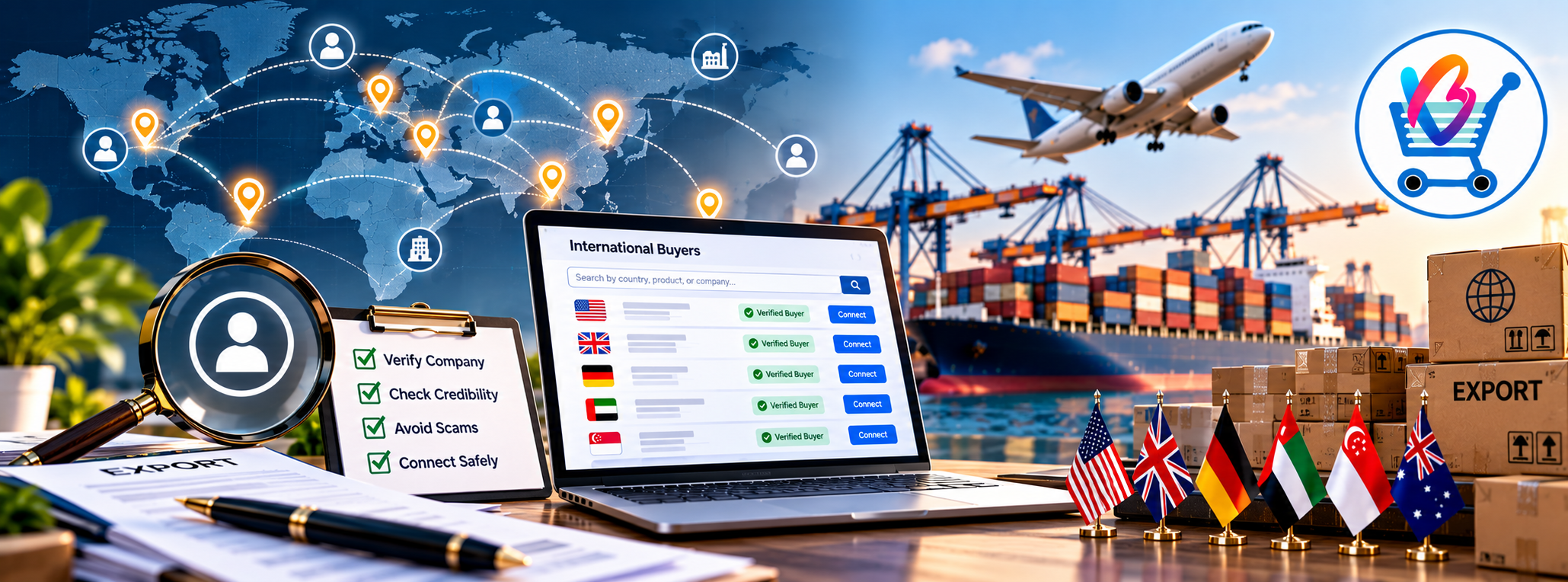
The safer way to find genuine overseas buyers is to build a research and verification pipeline rather than buy a large generic lead database. Start with the correct product and HS code, identify countries that already import the product, research real importers or distributors, find the right decision-maker, verify the company, qualify the requirement and then evaluate payment risk separately. Trade data, official export platforms, trade fairs, company websites and professional networks can all support discovery, but none of them removes the need for buyer verification.
- A company name in a paid database is not the same thing as a qualified or creditworthy buyer.
- Use UN Comtrade, ITC Trade Map and official trade channels to choose markets before collecting contacts.
- Research the company and the decision-maker before sending personalized outreach.
- Verify buyer identity before samples, production commitments or credit exposure.
- Treat buyer verification and payment-risk protection as two separate steps.
- A smaller verified pipeline is usually more useful than thousands of unqualified contacts.
Genuine overseas buyers are usually found through a process, not by purchasing a giant spreadsheet of “verified leads.” A useful export pipeline starts with the right product and target market, uses trade data and industry research to identify relevant companies, finds the right decision-makers, verifies the buyer, and only then moves to samples, quotations or payment discussions. A database can help with discovery, but no list by itself proves that a company is a genuine, active or creditworthy buyer.
| At a glance | Summary |
|---|---|
| Topic | How to Find Genuine Overseas Buyers Without Buying Fake Lead Databases |
| Core answer | Use the Quick Answer above for the direct answer, then use the sections below for the practical process, checks and next steps. |
| What to remember | Why it matters |
|---|---|
| Editorial note | For a first transaction, reduce payment risk through stronger verification and commercially suitable payment safeguards rather than relying only on the buyer's email, website or claimed order value. |
| Signal | What to verify |
|---|---|
| Identity | Legal company and buyer role |
| Order | Product, quantity and destination |
| Payment | Commercially credible payment mechanism |
| Pressure | Unusual urgency, secrecy or changed bank details |
Related step: export documents.
If you are still building the export setup itself, read How to Start an Export Business from India first. If your main problem is buyer outreach strategy, also see How to Find International Buyers for Export from India.
1. Why Buying a Lead Database Often Disappoints
A large buyer database can contain companies that are inactive, irrelevant to your exact product, too small for your MOQ, no longer importing, listed under a generic category, or represented by outdated contact details. Even when the company is real, the contact may not be responsible for procurement.
The problem is not that every paid database is fake. The problem is assuming that a row in a spreadsheet equals a qualified buyer. Discovery data and buyer qualification are two different things.
| Next step |
|---|
| Build a structured company and product presence so relevant B2B buyers can understand what your business manufactures, supplies or trades. |
List your business on BulkVyapar
2. Start With the Product and HS Code
Before searching for buyers, define the product clearly: specification, material, grade, packaging, MOQ, production capacity, lead time, price range and the relevant HS/ITC(HS) classification. This makes market research and company discovery much more precise.
For example, “food importer in Europe” is too broad. “Importer or distributor of Indian spice blends under the relevant HS category in Germany” is a much better research target.
3. Find Countries That Already Buy Your Product
Use trade data before choosing a market. UN Comtrade provides official international trade statistics by product, reporting country, partner country and trade flow. ITC Trade Map also provides trade indicators on international demand, alternative markets, competitors and, in some cases, importing and exporting companies.
The goal is not to predict your success from trade data. The goal is to avoid spending time on countries where your product has weak or unsuitable import demand.
4. Build a Buyer Profile Before Building a Contact List
Define what a realistic buyer looks like. Depending on the product, that may be an importer, distributor, wholesaler, OEM, retailer, brand owner, procurement company or industrial user.
Write down useful filters such as country, company type, product category, typical order size, distribution footprint, target customer, warehouse presence and whether the company already handles similar products.
5. Use Trade Data to Discover Markets, Then Research Companies
Trade data is strongest when used in two stages. First, identify attractive markets using import flows and product demand. Second, research companies within those markets using official directories, industry associations, trade-show exhibitor lists, importer/distributor directories, company websites, procurement portals and professional networks.
Do not export a thousand names and send the same email to all of them. A shortlist of 30 relevant companies can be more valuable than 5,000 unqualified contacts.
6. Use Trade Connect and Official Export Channels
India’s Trade Connect ePlatform is designed to help exporters access product and country information and connect with government trade-support entities. Its 'Source from India' service also allows eligible Indian exporters to showcase products and credentials for international buyer discovery.
Official channels can be useful for market intelligence, trade events, buyer-seller meets and export guidance, but they should still be combined with your own commercial qualification process.
7. Trade Fairs and Exhibitor Lists Can Be Better Than Random Lead Lists
Industry trade fairs reveal which companies are actively participating in a product category. Exhibitor, sponsor, speaker and visitor information can help you identify importers, distributors and category specialists.
Even if you do not attend the event, researching the official exhibitor list can produce a more relevant prospect list than buying a generic database.
8. Search Company Websites Before Sending Outreach
Before adding a company to your pipeline, review its website. Check whether the product category is actually relevant, whether the company has a physical address, whether it appears active, what brands or sectors it serves, and whether it has a procurement, sourcing, buying or category contact.
A real website does not prove creditworthiness, but it is one useful verification layer.
9. Find the Right Person, Not Just the Company
A buyer company can be genuine while your contact is wrong. Look for procurement managers, sourcing managers, category managers, import managers, buyers, founders or relevant commercial heads depending on company size.
Use company websites and professional networks to identify the right role. Your first message should refer to the company and product context, not look like a mass email.
10. Verify the Buyer Before Sending Samples or Giving Credit
Verification should become stricter as the commercial exposure increases. For an early enquiry, basic identity checks may be enough. Before expensive samples, production on credit or a large shipment, verify the buyer more deeply.
Useful checks can include company registration where accessible, address consistency, domain and email identity, website history, product relevance, buyer role, trade references, banking details, previous trade activity where reasonably verifiable, and whether the requested payment structure makes commercial sense.
11. Separate Buyer Verification From Payment-Risk Protection
A company can be genuine and still fail to pay. Buyer identity verification and payment-risk management are separate tasks. ECGC’s buyer-specific policy materials explicitly discuss commercial or buyer risk, political risk and LC-opening bank risk. That is a useful reminder that a real buyer is not automatically a low-risk buyer.
Payment terms, credit limits, letters of credit, advance payments, export credit insurance and bank guidance should be evaluated according to the buyer and order size.
12. Warning Signs in Overseas Buyer Enquiries
| Warning sign | Why it matters |
|---|---|
| Free email account for a large company | May not match the claimed corporate identity |
| Urgent large order with little product discussion | Commercial behaviour may not match a real procurement process |
| Refuses video call or company verification | Makes basic identity checks difficult |
| Website, address and email domain do not match | Can indicate impersonation or poor identity consistency |
| Unusual request to pay a third party | Creates payment and fraud risk |
| Asks for expensive samples immediately | May be sample harvesting rather than genuine buying intent |
| Requests long credit before any relationship | Creates avoidable receivable exposure |
| Cannot explain specification, quantity or destination | May not be a qualified buyer |
13. How to Write the First Buyer Message
The first message should be short and specific. Mention the product, why the company looks relevant, one or two commercial strengths, and a clear next step. Avoid long company introductions and generic claims such as 'best quality at best price.'
A good message makes it easy for the buyer to answer: product specification, target quantity, current sourcing market, preferred packaging or whether a catalogue/sample discussion would be useful.
14. Follow Up Without Spamming
Many real buyers do not reply to the first message. Use a small, professional follow-up sequence. Each follow-up should add context, such as a product specification, relevant catalogue, certification, production capacity or a question tied to the buyer’s market.
If there is no response after a reasonable sequence, move the company to a later follow-up list instead of repeatedly emailing the same message.
15. Qualify the Buyer Before Quoting Your Best Price
Before offering your lowest possible price, understand the requirement. Ask about specification, quantity, destination, packaging, target timeline, Incoterm and payment expectations. A request for 'best price' without commercial details is not enough to price a serious export order.
16. Build a Repeatable Buyer Pipeline
Track prospects in stages such as researched, contacted, replied, qualified, sample requested, quotation sent, negotiation, won, lost and follow-up later. Record the source of each lead and why the prospect was qualified or rejected.
This turns buyer acquisition into a repeatable process instead of a cycle of repeatedly buying new databases.
17. Practical Overseas Buyer Verification Checklist
| Check | What to verify |
|---|---|
| Company identity | Legal/business name, website, address and contact details are consistent |
| Product relevance | The company genuinely handles your product or category |
| Decision-maker | You are speaking with an appropriate buyer, sourcing or procurement contact |
| Requirement | Specification, quantity, destination and timeline are clear |
| Digital footprint | Website, domain, professional presence and contact information are credible |
| Commercial history | Available references or trading evidence support the buyer’s claims |
| Payment terms | Requested terms fit the relationship and order risk |
| Bank/payment identity | Beneficiary and payment instructions are consistent with the contracting party |
| Sample request | Sample cost and purpose are commercially reasonable |
| Next step | Quotation, sample, meeting or follow-up date is clearly recorded |
18. Where BulkVyapar Fits Into Buyer and Supplier Discovery
BulkVyapar is a B2B discovery platform, not a guarantee of overseas orders. Its value is in making manufacturers, suppliers, products and business profiles more structured and discoverable so buyers and sellers can find relevant businesses more efficiently.
Exporters can use Find Manufacturers & Suppliers when building a domestic sourcing network, and can List Your Business to create a structured company presence. Commercial verification should still be completed before any meaningful transaction.
19. A Simple 30-Day Buyer-Research Plan
| Period | Action |
|---|---|
| Days 1–3 | Finalize product, HS code, MOQ, capacity, pricing logic and target buyer profile |
| Days 4–7 | Use trade data to shortlist 2–3 promising countries |
| Days 8–14 | Research 30–50 relevant importers, distributors or industrial buyers |
| Days 15–20 | Verify companies and identify the right procurement contacts |
| Days 21–25 | Send personalized outreach and record replies |
| Days 26–30 | Follow up, qualify serious enquiries and move weak leads out of the active pipeline |
20. Common Mistakes to Avoid
Buying thousands of contacts before choosing a market
Market and product fit should come before bulk contact collection.
Calling every enquiry a buyer
A buyer should be qualified through identity, relevance, requirement and commercial intent.
Using only one discovery source
Combine trade data, official trade platforms, industry sources, websites, events and professional networks.
Skipping payment-risk checks
A genuine company can still default. Verification and payment protection are separate.
Mass-emailing generic messages
Personalized, relevant outreach produces a stronger signal than sending the same email to thousands of companies.
Important Note
This article provides general business information and does not guarantee that any buyer, directory, database or marketplace lead is genuine or creditworthy. Exporters should independently verify counterparties, payment instructions and commercial terms before sending money, granting credit or committing significant production. Reviewed against official information available on 30 September 2026.
Related BulkVyapar Guides
Continue with these related BulkVyapar guides for the next practical step.
| Business action |
|---|
| Use clear product information and relevant guides to move from discovery to a better B2B conversation. |
Create your BulkVyapar business profile
| Written by | Editorial approach |
|---|---|
| BulkVyapar Editorial Team | Practical Indian B2B guidance with official-source verification where regulations, platform features or market processes can change. |
Frequently Asked Questions
Are paid export buyer databases always fake?
No. Some databases contain useful company or trade information. The risk is treating database entries as automatically verified, active or qualified buyers. Every serious prospect still needs independent research and verification.
How can I find importers for my product?
Start with the correct HS code and use trade data to identify countries importing the product. Then research importers, distributors, industry associations, trade fairs, company websites and official export-support channels in those markets.
How do I verify an overseas buyer?
Check company identity, address, website and domain consistency, product relevance, the contact person’s role, available company records or references, commercial requirement and payment instructions. Verification should become stricter as order value and credit exposure increase.
Does a company website prove that the buyer is genuine?
No. A website is only one verification layer. It should be combined with business identity, contact, commercial and payment checks.
Should I give credit to a buyer after verification?
Not automatically. A genuine buyer can still create payment risk. Credit terms, insurance, banking instruments and other risk controls should be evaluated separately.
Can BulkVyapar guarantee international buyers?
No. BulkVyapar can support B2B discovery and structured business visibility, but exporters must independently qualify and verify buyers and commercial terms.
Official Sources
- UN Comtrade — Trade Data Official United Nations trade database for product, reporter, partner and import/export flow analysis.
- International Trade Centre — Trade Map ITC market-analysis resource covering international demand, alternative markets, competitors and trade statistics.
- DGFT / Trade Connect — Source from India Government Trade Connect service designed to help international buyers discover eligible Indian exporters and their products.
- DGFT — Trade Notice 15/2025-26 Official notice describing the Source from India service and updated exporter eligibility.
- ECGC — Exports (Specific Buyers) Policy Official ECGC material illustrating buyer/commercial, political and LC-opening-bank risks in export transactions.
